
Expert training for independent consultants joining our network
Helping a beneficiary set up his/her own business


Objectives
At the end of the course, you should be able to support an employee or job-seeker in his or her business start-up project, from conception to launch.
Target audience & prerequisites
Duration & Organization
The training program lasts 35 hours, or a total of 5 training days, including:
- 14 hours of asynchronous distance learning, equivalent to 2 days' training,
- 21 hours of synchronous face-to-face or remote training over 3 consecutive days.
The course
The "Accompanying a beneficiary in setting up a business" training program aims to acquire and validate the following skills:
Define the concept, services or products
- Help the candidate determine the structure of their business by considering key factors (company size, investment amount, number of partners, etc.),
- Help the candidate define the scope of their concept—including services, products, and the "customer promise"—or choose a franchise system.
Test the concept in terms of potential, development and profitability
- Test the concept by direct confrontation with the market,
- Evolve the concept, fine-tune it before launch,
- Work on your business model, looking for a low "break-even" point.
Choosing a legal status and asset strategy
- Learn about the different legal forms and their social, tax and legal consequences, so you can choose the form best suited to your project,
- Be aware of the pitfalls to avoid in terms of asset choices, particularly in relation to your matrimonial situation (PACS, marriage, etc.).
Writing the business plan
- Assist the candidate in drafting this essential summary document—the business plan—in preparation for presenting their project to financial partners for fundraising (banks, business angels, etc.).
Conclusion: Assist the candidate in drafting a summary ( sincethe business plan is not included in all support packages, the summary serves as a substitute for those packages that do not include it).
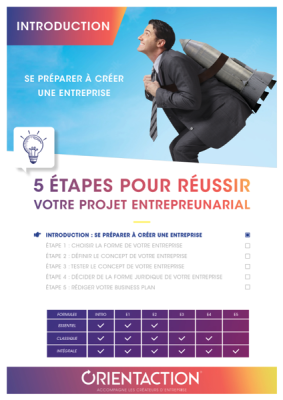
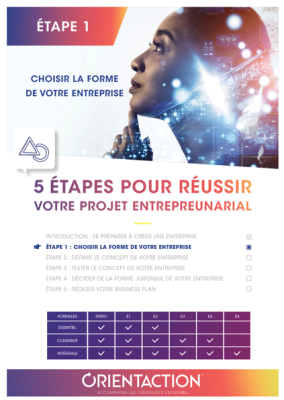
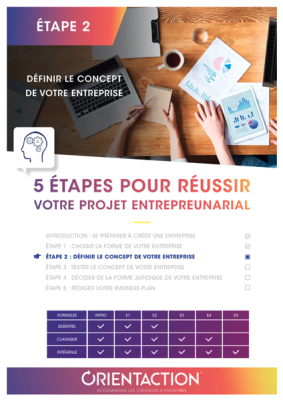
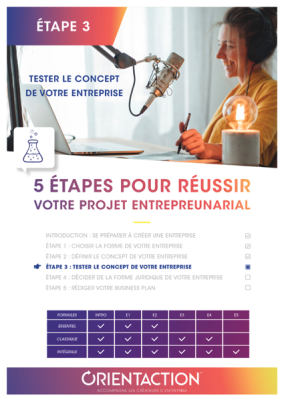
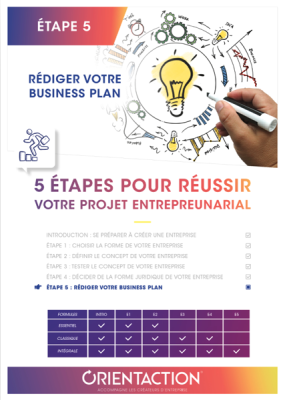
The 6 ebooks of the ORIENTACTION® coaching method

Methodology
The methodology was developed by Emeric Lebreton, Doctor of Psychology and founder of the ORIENTACTION group. Since the start of his professional career, Dr. Emeric Lebreton has proven himself to be a true expert in the art of business creation. A serial entrepreneur at just 40 years old, Dr. Emeric Lebreton has gained a wealth of experience in this field, having himself created four companies with different legal statuses:
- Founder of the ORIENTACTION group: A national network of firms specializing in professional and personal support, which currently has more than 900 consultants.
- Founder of Psy'Action®: a network of practices specializing in general and health psychology,
- Founder of the "Apprendre à Réussir®" brand: a school specializing in career guidance, academic coaching, and preparation for entrance exams to prestigious universities,
- Director of ULYS: Political Communications Consultancy,
Dr Emeric Lebreton is also :
- Researcher in the humanities and social sciences,
- Political communications advisor: works with politicians to help them promote their ideas and beliefs.
- Author of best-selling books: he has written several professional works, including: Psy’Action: Psychoanalysis in the 21st Century, 50 Inspiring Stories for Happiness, The 10/10 Method for
, What I Would Like to Tell You, and Better Emotion Management.
Certification
This training program leads to the issuance of a certificate of competence for providing business startup support. This certificate is not a state-recognized degree. It grants access to all the tools and methodological resources used by ORIENTACTION in the context of business startup support. These tools may be used freely for commercial purposes provided the individual belongs to the ORIENTACTION group (subcontract, brand licensing and commercial partnership agreement, or fixed-term usage agreement). Awarding of this certificate is contingent upon passing the multiple-choice tests assessing knowledge and skills.
Target skills
This training aims to develop six skills in supporting business creation:
-
Help aspiring entrepreneurs prepare for their future "career," its challenges, risks, and opportunities,
-
Help aspiring entrepreneurs define the structure and concept of their business, as well as its business model,
-
Support aspiring entrepreneurs during the pilot phase of their business concept to ensure its viability,
-
Help aspiring entrepreneurs choose the legal structure for their future business,
-
Help aspiring entrepreneurs draft their business plans.
Teaching resources, methods and supervision techniques
Most employees or job-seekers who want to start their own business are often plagued by a number of prejudices that need to be corrected. Having a more accurate, "real-life" vision of what it's like to be an entrepreneur will enable them to adopt winning attitudes and make a success of their business start-up.
The teaching methods used in this training program are based on six e-books that provide a framework for the entire process of supporting individuals starting a business. The e-books contain texts, assessment questionnaires, and tests that training participants will learn to use by following this teaching method: they take the tests themselves, analyze the results collaboratively, and then apply what they’ve learned in role-playing exercises.
Course Requirements
There are several possible organizational arrangements :
MEANS OF ORGANIZING FACE-TO-FACE TRAINING
The training will be conducted:
- At the ORIENTACTION offices in Le Mans.
METHODS FOR ORGANIZING DISTANCE LEARNING (SYNCHRONOUS)
- Training will be carried out via synchronous distance learning using the ZOOM tool,
- Links to ZOOM will be provided by the training center.
ASYNCHRONOUS DISTANCE LEARNING
Asynchronous distance learning is based on a set of reference materials provided to the trainee in advance and organized into four sections:
1. Books to read (recommended reading list),
2. Recommended filmographies,
3. Review of the manuals for the business startup support program,
4. Preparation of financial statements.
These documents should be reviewed prior to the in-person or synchronous online training session .
Pedagogical and technical support and assistance
Educational support and technical assistance for distance learning are provided by the training department throughout the trainee’s program.
The training department is available to answer questions regarding the training process, the use of digital tools, access to educational resources, and any difficulties encountered during the training.
Requests can be submitted by email, and we will process them as soon as possible, or by phone in case of an emergency requiring immediate attention.
The full contact information for the training department is provided to the trainee upon signing the training contract and is also included in the welcome booklet provided at the start of the program.
Means for monitoring action implementation and results
During the training, you :
- Fill in an attendance sheet and a satisfaction questionnaire to assess the quality of the training (trainer's pedagogical skills, quality of teaching aids, etc.),
- You will take a multiple-choice knowledge assessment at the end of the in-person or synchronous online training session to evaluate your level of knowledge upon completion of the training.
People with disabilities
Training is open to all, and all types of disability will be taken into account, within the limits of the skills, human and material resources available for the training provided. If ORIENTACTION does not have the material, technical and human resources to meet the needs of a disabled participant, the latter will be referred either to the ORIENTACTION group's disability advisor, or to a partner organization in the ORIENTACTION network.
Access procedures and deadlines
All training requests are accompanied by a quote specifying the total cost (including tax) of the training, as well as the dates on which it will take place. The quote is sent electronically via email. Once the quote has been accepted and the training contract or agreement has been signed, the training may begin after a minimum waiting period of 30 calendar days, which allows for remote training, among other things. For information on the terms and conditions for postponing or canceling the training, please refer to the Terms and Conditions available by clicking here: https://www.orientaction-groupe.com/cgv/
Price and financing of your service
- 2,500 euros incl. VAT for 35 hours of training, i.e. 71.43 euros / hour.