
Expert training for independent consultants joining our network
Supporting a skills assessment recipient


Objectives
At the end of the course, you should be able to guide a skills assessment recipient (employee, job-seeker, company director) in defining his or her career development project, respecting the different phases of the process (preliminary phase, investigation phase and conclusion phase).
You must also be able to conduct an informational interview regarding skills assessments and handle the various related administrative tasks (quotes, funding applications, training contracts or agreements, attendance sheets, completion certificates, etc.) while adhering to the QUALIOPI quality standards.
Target audience & prerequisites
Duration & Organization
The training course lasts 42 hours, i.e. a total of 6 training days, including :
- 21 hours of asynchronous distance learning, equivalent to 3 days' training,
- 21 hours of synchronous face-to-face or remote training over 3 consecutive days.
The course
The "Accompanying a beneficiary of a skills assessment" training course is divided into three main parts.
The information interview
- Making appointments.
- Welcoming people.
- The interview process :
- Reminder of interview objectives,
- Identifying the person's expectations,
- Method presentation,
- Validation of the approach.
- Contractualization.
Administrative tasks
- Contractualization documents,
- Qualiopi quality monitoring documents,
- Attendance sheet,
- The summary document,
- Evaluation questionnaires.
Accompanying the beneficiary of a skills assessment through the three main stages (preliminary phase, investigation phase and conclusions phase)
This section covers the structure of the various interviews. For each interview, you will become familiar with the tools that may be used to support the educational progress outlined in the skills assessment, in accordance with the three regulatory phases: the preliminary phase, the investigative phase, and the conclusion phase.
Finally, special attention will be given to drafting the summary of the skills assessment, particularly the pace and method of drafting, as well as the various templates that can be used.
Interview #1: Analysis of professional and personal background
Interview #2: Analysis of aspirations (scenarios/values/meaning)
Interview #3: Analysis of aspirations (needs/personality)
Interview #4: Exploration of possibilities and first choice
Interview #5: Analysis/documentation of skills
Interview #6: Analysis/documentation of skills
Interview #7: Commitment and definition of the action plan
Interview #8: Finalization of the summary and evaluation
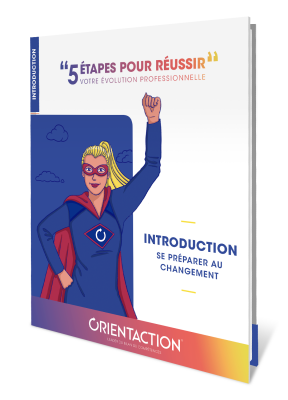
The ORIENTACTION® skills assessment method Ebooks


Target skills
The "Accompanying a beneficiary of a skills assessment" course aims to acquire and validate the following three skills:
-
Conduct an informational interview regarding skills assessment by following three steps (understanding the client’s needs, presenting the support methodology, and identifying a support solution) in order to validate the client’s approach and, if applicable, implement the service,
-
Support the beneficiary through the various phases of the skills assessment as defined in the Labor Code (Articles R.6313-4 through R.6313-8) (preliminary phase, investigation phase, conclusions phase) by following the support methodology developed by ORIENTACTION to enable the beneficiary to develop a realistic and coherent career development plan,
-
Perform administrative tasks (such as preparing quotes, drafting training contracts or agreements, and signing attendance sheets) by completing the necessary regulatory documents, in order to establish and verify that the service has been successfully provided.
Teaching resources, methods and supervision techniques
The pedagogical methods used in the training program are based on 6 Ebooks which structure the entire process of supporting the beneficiary of a skills assessment. The Ebooks contain texts, self-assessment questionnaires and tests, which course participants will learn to use using the following pedagogical method: they take the tests themselves, analyze the results collectively, and then present them in real-life situations.
Regarding the informational interview on the skills assessment, training participants are asked to conduct mock interviews in front of the other participants. The other participants and the trainer, using an evaluation rubric, provide feedback on the participant’s performance and suggest areas for improvement. Regarding administrative tasks, training participants compile a complete administrative file to facilitate the implementation and certification of the skills assessment.
Course Requirements
There are several possible organizational arrangements :
MEANS OF ORGANIZING FACE-TO-FACE TRAINING
The training will be conducted:
- At the ORIENTACTION offices in Le Mans.
METHODS FOR ORGANIZING DISTANCE LEARNING (SYNCHRONOUS)
Training will be carried out via synchronous distance learning using the ZOOM tool,
Links to ZOOM will be provided by the training center.
Asynchronous distance learning
Asynchronous distance learning is based on a set of audio documents organized into 4 sections:
- Introduction to the method,
- The skills assessment information interview,
- Administrative tasks,
- Supporting the participant in the skills assessment through its three main stages (preliminary phase, exploration phase, and conclusion phase),
These audio files should be listened to prior to the in-person or synchronous online training session. Participants are also required to read a book that serves as the theoretical foundation for the training.
Pedagogical and technical support and assistance
Educational support and technical assistance for distance learning are provided by the training department throughout the trainee’s program.
The training department is available to answer questions regarding the training process, the use of digital tools, access to educational resources, and any difficulties encountered during the training.
Requests can be submitted by email, and we will process them as soon as possible, or by phone in case of an emergency requiring immediate attention.
The full contact information for the training department is provided to the trainee upon signing the training contract and is also included in the welcome booklet provided at the start of the program.
Means for monitoring action implementation and results
During the training, you :
- Fill in an attendance sheet and a satisfaction questionnaire to assess the quality of the training (trainer's pedagogical skills, quality of teaching aids, etc.),
- You will take two multiple-choice quizzes to assess your knowledge: the first at the beginning of the in-person or synchronous online training session to evaluate what you have learned during the online portion, and the second at the end of the in-person or synchronous online training session to assess your level of knowledge upon completion of the entire training program.
After the training, you :
- Create a video presentation of the skills assessment as part of the informational interview (based on an MP3 audio file).
This training program leads to the issuance of a certificate of competencefor providing career assessment support services. This certificate is not a state-recognized degree. It grants access to all the tools and methodological resources used by ORIENTACTION in the context of career assessment support. These tools may be used freely for commercial purposes, provided the user belongs to the ORIENTACTION group (subcontract, brand license and commercial partnership agreement, or fixed-term service contract). Awarding of this certificate is contingent upon passing the multiple-choice knowledge assessment and producing the presentation video.
People with disabilities
Training is open to all, and all types of disability will be taken into account within the limits of the skills, human and material resources available for the training course. If ORIENTACTION does not have the material, technical and human resources to meet the needs of a disabled participant, the latter will be referred either to the ORIENTACTION group's disability advisor, or to a partner organization of the ORIENTACTION group.
Access procedures and deadlines
All training requests are accompanied by a quote specifying the total cost (including tax) of the training, as well as the dates on which it will take place. The quote is sent electronically via email. Once the quote has been accepted and the training contract or agreement has been signed, the training may begin after a minimum waiting period of 30 calendar days, which allows for remote training, among other things. For information on the terms and conditions for postponing or canceling the training, please refer to the Terms and Conditions available by clicking here: https://www.orientaction-groupe.com/cgv/
Certification
This training course is the first module in the training program leading to the certification “Supporting a Client Through a Skills Assessment,” listed in the specific directory by France Compétences (RS6340). Completing this training course provides access to all the tools and methodological resources used by ORIENTACTION in the context of skills assessment support. These tools may be used freely for commercial purposes provided you are a member of the ORIENTACTION group (subcontract, brand licensing and commercial partnership agreement, or fixed-term service contract).
The certification “Supporting a Participant Through a Skills Assessment” was listed in the France Compétences Specific Directory (RS) under number 6340 on July 19, 2023, by the certifying body ORIENTACTION.
Price and financing of your service
€1,500 including tax for 42 hours of training, or €35.71 per hour.