




AND BECOME YOUR OWN BOSS?
Creating a successful business
If you want to become self-employed, get started with ORIENTACTION®.
Objectives
The objective of the business start-up training offered by ORIENTACTION is to help you realize your business start-up project and ensure the long-term success of your business. To achieve this objective, this training will enable you to:
- Define a concept in line with your aspirations, skills and the market. with the development potential to match your expectations and ambitions in terms of economic and human development.
- Test the viability of your concept in real-life conditionsThis means assessing your concept's commercial potential and the profitability of your business model, in particular its ability to generate a return in line with your expectations.
- Choose a sustainable business model and legal structure allowing you to optimize your remuneration, reduce your costs and benefit from all tax and social security advantages in compliance with the law.
- Writing your business plan so that you have a detailed communication tool to present to financial and/or commercial partners. Along with a business forecast, the business plan is the entrepreneur's CV.
The objectives of this training depend on the type of support you choose.
Objectives 1 and 2 concern the "essentiel" formula, objectives 1, 2 and 3 concern the "classique" formula and objectives 1, 2, 3 and 4 concern the "intégrale" formula.
Over the past 15 years, ORIENTACTION has helped more than 65,000 people transition into new careers. The thousands of positive reviews and suggestions for improvement we’ve received have enabled us to develop a proven skills assessment method that boasts a very high satisfaction rate and a low dropout rate.





-
ORIENTACTION's business start-up coaching aims to develop specific entrepreneurial skills:
-
Self-evaluation
Self-assess (or with the help of tests) your entrepreneurial skills and build a personalized skills development plan,
-
Defining a concept
Define a business concept (products, services, mix) by developing a marketing strategy based on an offer-based approach,
-
Assessing the viability of a concept
Set up a full-scale test to assess the viability of a concept in terms of in terms of market potential,
-
Differentiating status
Differentiate between the different types of company status and their social, tax and legal constraints,
-
Writing a business plan
Draw up a business plan (or simplified business plan) by formalizing the various sections and present it to financial partners,
-
Make a business forecast
Drawing up a business forecast in partnership with a chartered accountant.
-
Target audience and prerequisites
Support for business creation is aimed at employees and job seekers who plan to start a business and wish to develop the entrepreneurial skills needed to launch, implement, and develop their business creation project and ensure its long-term viability. A good understanding of the French language is necessary to use the training materials.
The training is aimed at individuals wishing to set up a business with a separate legal entity (limited liability company, simplified joint stock company, etc.) or self-employment projects. Each candidate for the training program will be given a business creation test to assess their aptitude for starting a business. ORIENTACTION also undertakes to assess its own ability to support the project and to refuse support if it does not have the required level of expertise.
Teaching resources, methods and supervision techniques
During the business start-up support program, the beneficiary is accompanied by a trainer and business start-up support consultant. The trainer may use the following techniques:
-
Specialized tests
-
Evaluation questionnaires
-
Knowledge transfer
(market, business concepts, franchise concepts, etc.).
-
Delivery of training materials Ebooks
-
Field business survey
-
Connection to a network of experts
-
Co-editing a synthesis
(review of approach, project and action plan)
The course
Different types of business start-up support
ORIENTACTION offers three business start-up support packages.
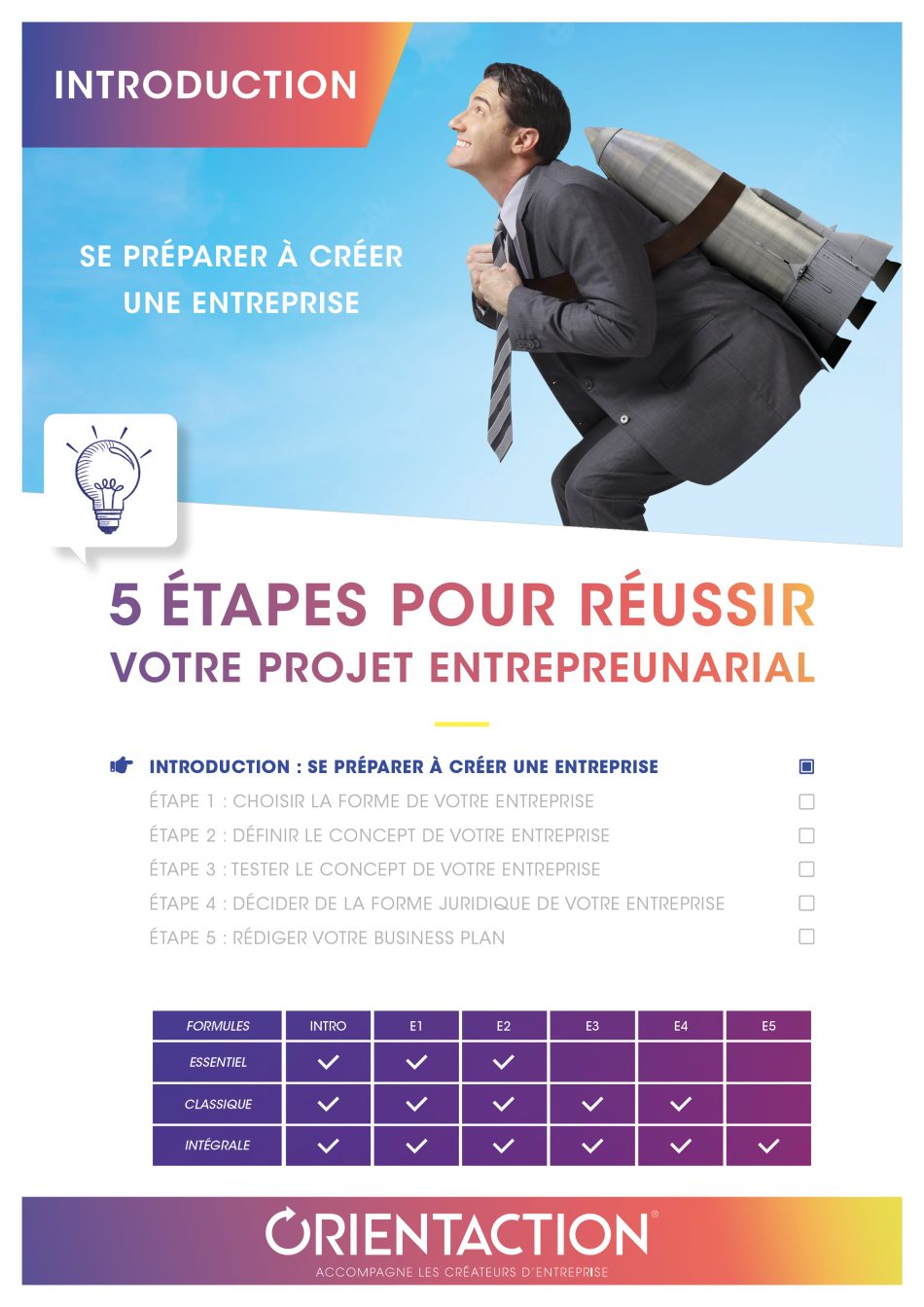
Introduction: Preparing to start a business
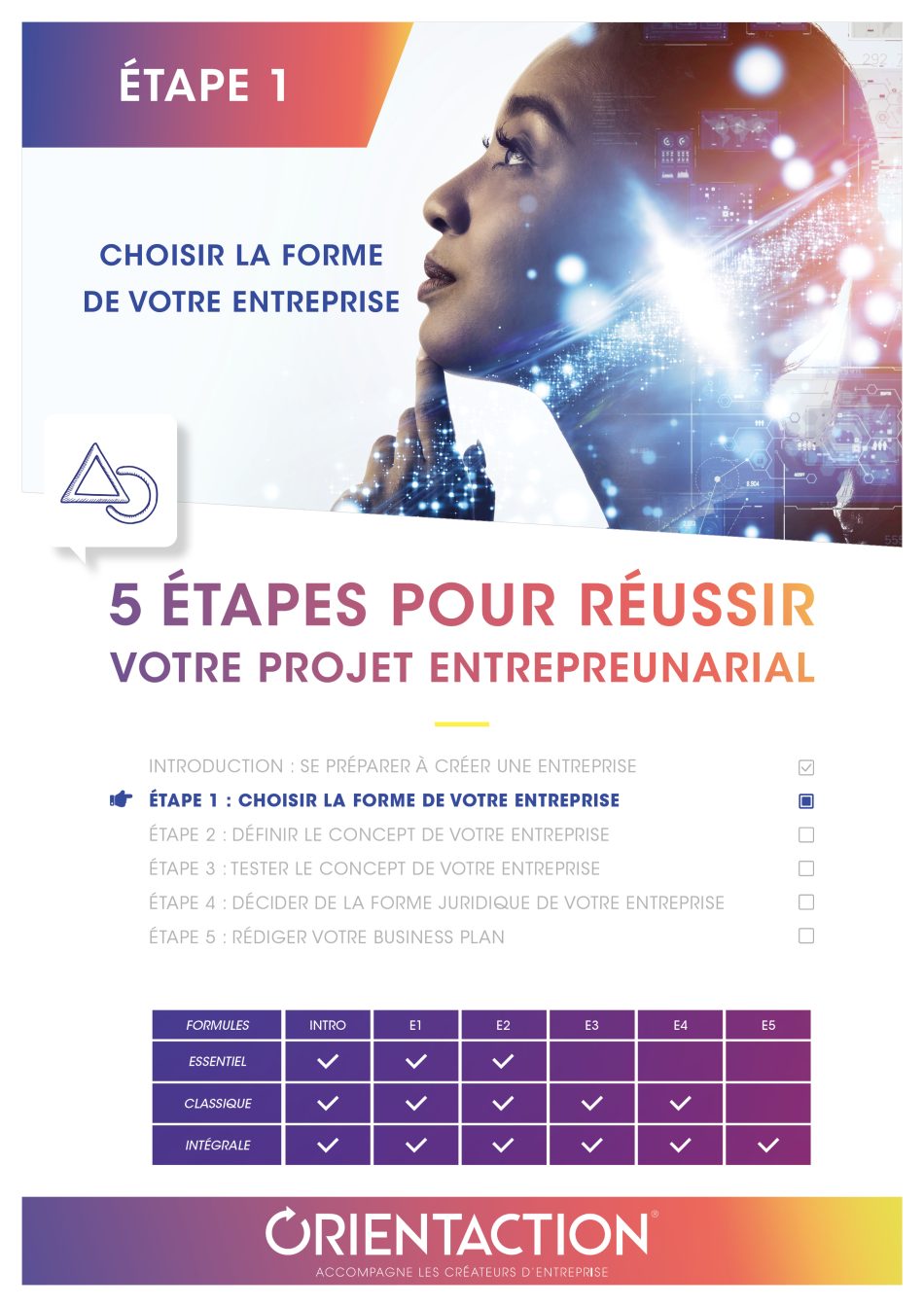
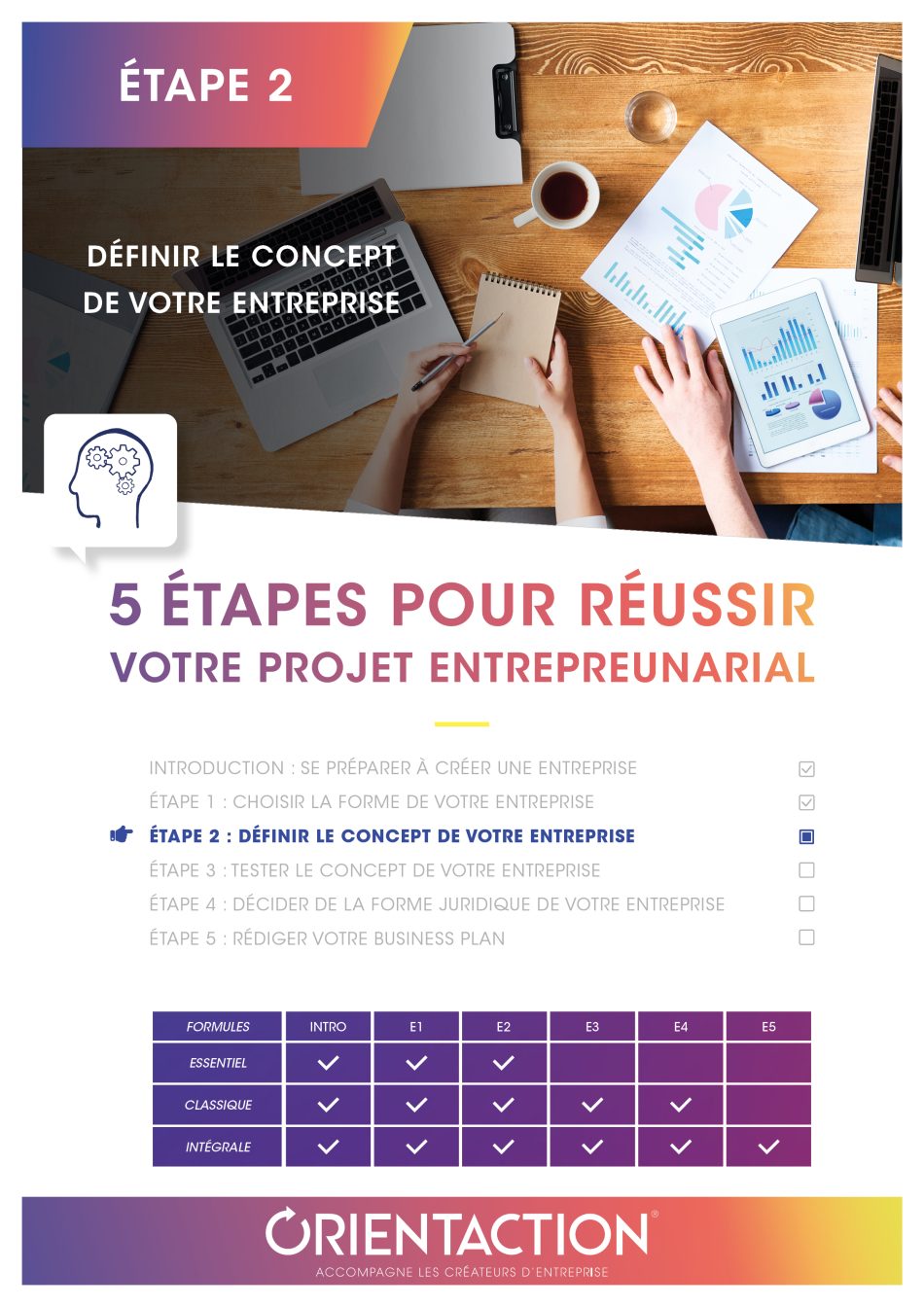
- Essential Package:
Step 1: Choose the form of your business
Step 2: Define your business concept - Classic Package:
Step 3: Test your business concept
Step 4: Decide on the legal form of your business - Full Package:
Step 5: Write your business plan
The course is structured around the acquisition of five key skills specific to business start-ups. Each stage corresponds to the acquisition of one of these skills. Training takes the form of personalized one-to-one interviews with a consultant specialized in business start-up support. Each consultant has already created and managed at least one business. All consultants who work with entrepreneurs are also trained in the Orientaction method.
Step 1: Choosing your business form
There are many different types of business: small or large, product or service (or mixed), with or without partners, with or without investment, start-up, takeover or franchise, and so on. It's not always easy to project yourself into these different forms and measure their concrete implications. This step will enable you to visualize as precisely as possible the entrepreneurial style corresponding to each type of project, so that you can make your own choices and define the form of your business.
Entrepreneurial skills acquired: better understanding of the consequences of your choices (company size, number of partners, marketing mix, investment amount, etc.).
Step 2: Define your business concept
Whether you're starting from an idea you've cherished for a long time, or from a blank page, it's important to define your company's concept. A well-defined concept will enable you to position yourself intelligently in the market and offer attractive products/services. If you opt to set up your business under a franchise agreement, we can support you in your choice of concept, providing you with the knowledge you need to carry out an in-depth study of the entrepreneurial, legal and accounting aspects of the systems you have selected.
Entrepreneurial skills acquired: define a business concept based on a supply-side strategy. Understand basic marketing concepts, including customer needs analysis.
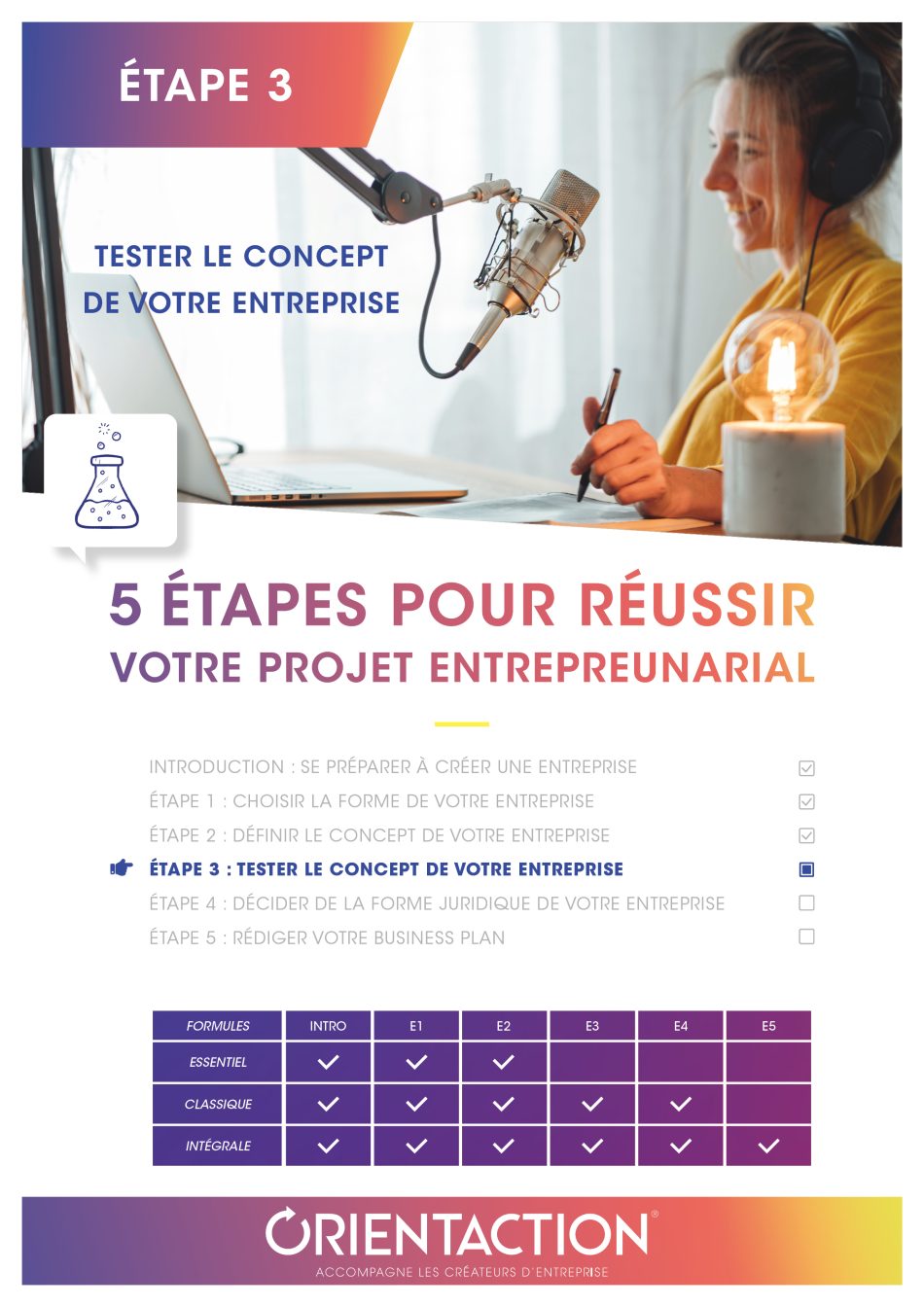
Step 3: Test your business concept
The ORIENTACTION method is a market research method based on comparing the product/service with the consumer's needs. The idea is to quickly confront your idea with a sales situation, so as to test its real attractiveness. Rather than a theoretical market study based on statistical readings and analyses, you go out and meet your future customers. If you don't succeed in convincing them, you'll either have to change your product/service, evolve it or offer something else.
Entrepreneurial skills acquired: conduct a business survey. Conduct full-scale product tests to assess product/service/market potential.
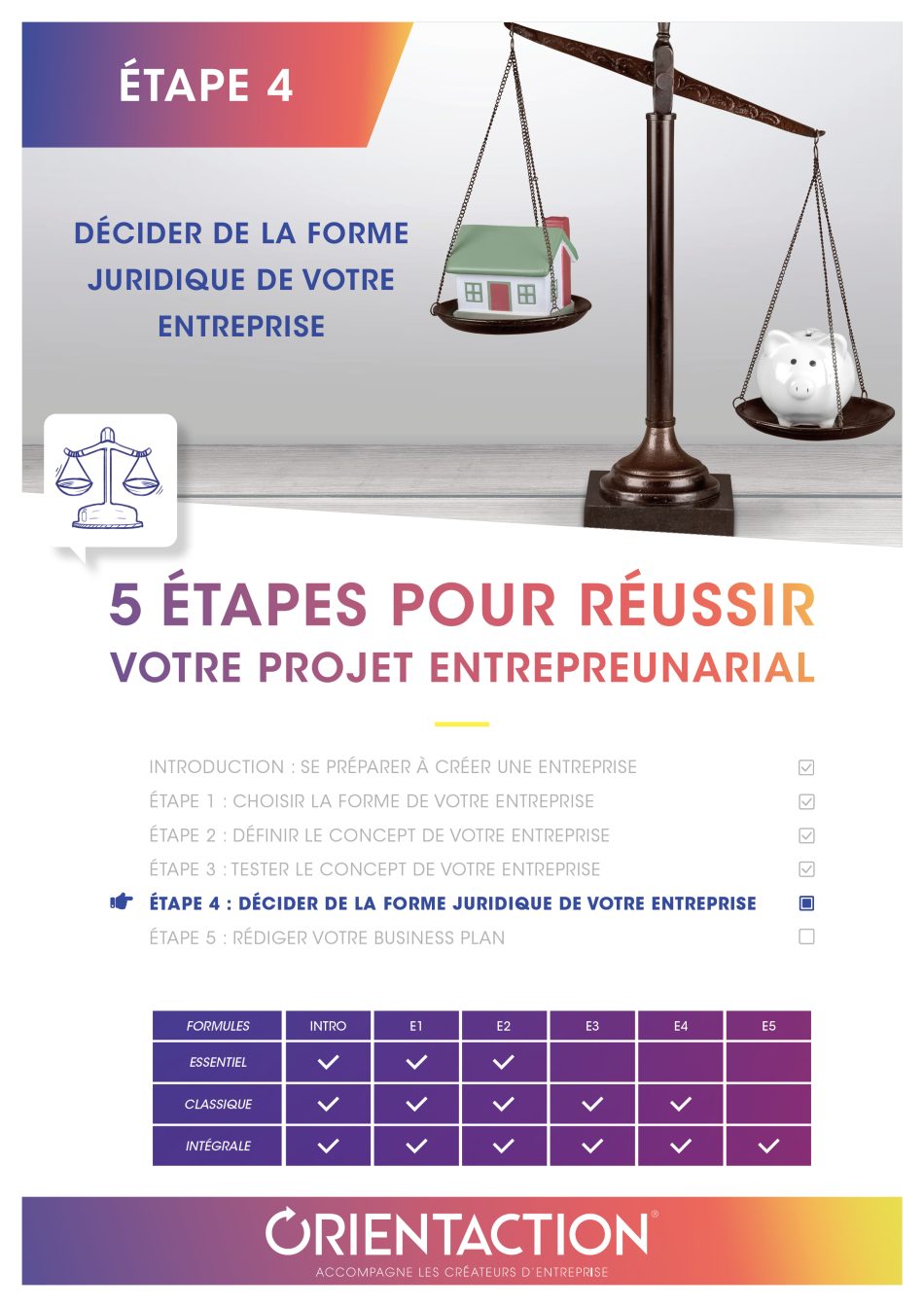
Step 4: Decide on the legal form of your company
There are several possible legal forms for setting up a business. Each has its advantages and disadvantages. The aim is to choose the legal status of your future business according to your personal situation (age, desired level of remuneration, etc.). In addition, a question that is rarely addressed in business start-up coaching, but which ORIENTACTION intends to address, is the question of assets. When a company is set up, certain steps have to be taken in the presence of a notary.
Entrepreneurial skills acquired: know the different types of status and be able to choose the most appropriate status (tax, social, etc.). Anticipate financial risks.
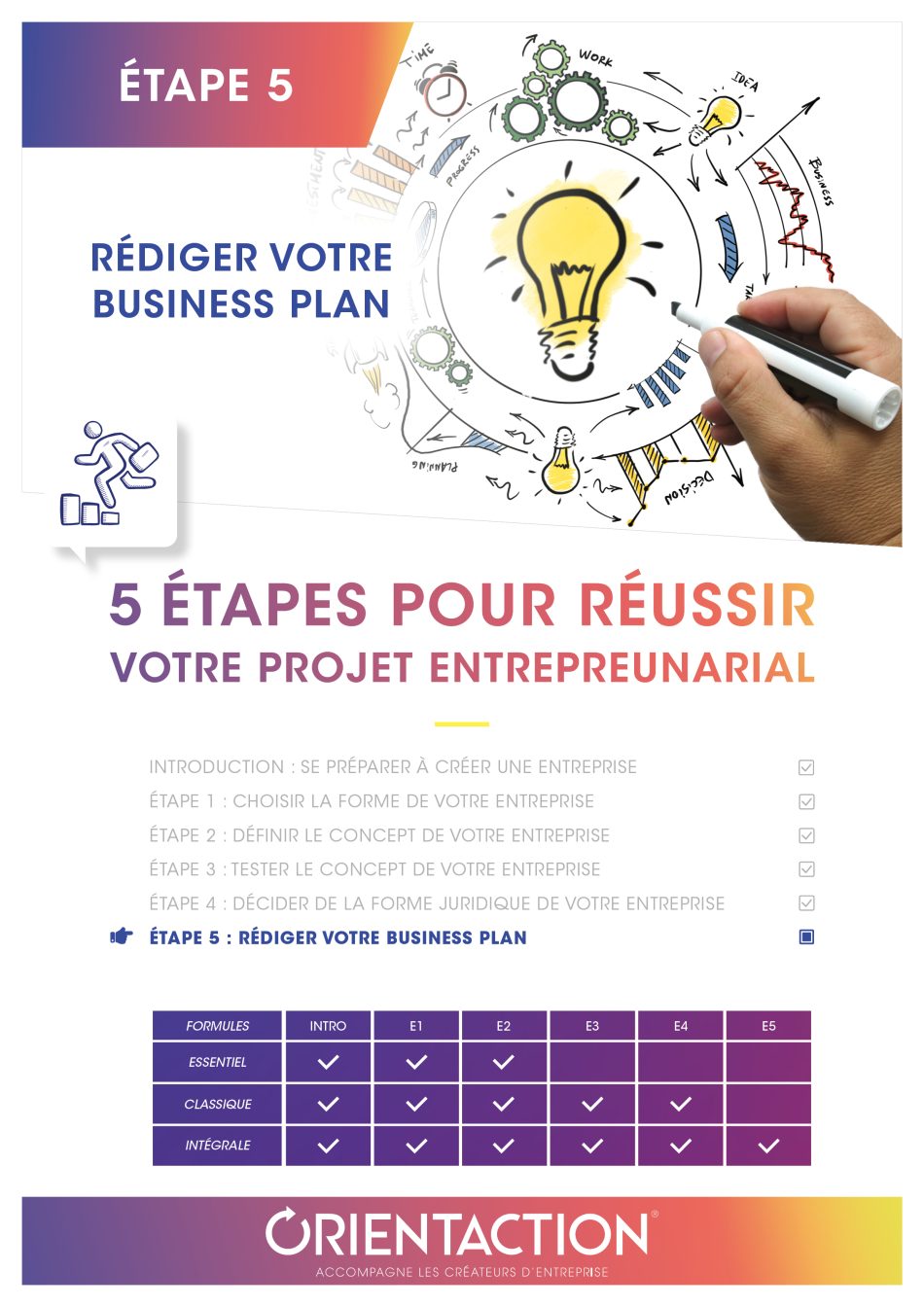
Step 5: Write your business plan
The business plan is a document that your banking partners will ask for when assessing your loan application. If you have opted for a franchise system, the franchisor can provide you with this document or a draft. If you've opted for a pure start-up, it's up to you to draw it up. There are several important sections to be formalized, including the creator's background, the definition of the business concept and the financial analysis. The business plan should ideally be completed by a business forecast.
Entrepreneurial skills acquired: present your business creation project to a bank, business angel or investment fund.
At the end of the support, in the "essential" formula, a summary is co-written with the training beneficiary. This summary summarizes the main conclusions of the support provided. In the classic formula, a simplified simplified business plan and in the integral formula the business plan. In addition, the entrepreneur will present his or her project to two business leaders. The aim is to challenge the project, enabling the entrepreneur to improve it still further. The presentation will also provide good training for the rest of the process.
Conditions for distance learning
Ways of organizing distance learning
Distance learning is based on workbooks containing all the knowledge to be integrated, exercises to be carried out and tests. These Ebooks are handed out at the end of each interview with the beneficiary (for example, at the end of interview n°1, the beneficiary is given Ebook n°1). The trainer explains the contents of the Ebook and gives oral instructions to the beneficiary. Following the Ebook, the beneficiary completes the tests and exercises according to the instructions given.
Pedagogical and technical support and assistance
Coaching and assistance are provided by the same trainer as for the face-to-face business start-up coaching. Exchanges take place by email or, in an emergency, by telephone. The trainer's contact details are given to the beneficiary at the start of the course. The trainer must reply within 48 hours.
If the trainer cannot be reached, the beneficiary can contact the person in charge of training, whose contact details are given in the ORIENTACTION Welcome Booklet.
ORIENTACTION ensures that the trainer has the necessary skills to provide support and assistance for distance learning. All trainers wishing to provide business start-up support for ORIENTACTION must attend a training course. The course is entitled "Accompanying a beneficiary in setting up a business". It leads to a skills certificate. The aim of the course is to acquire the skills needed to provide "face-to-face" and "distance" support.
Means for monitoring action implementation and results
- During the business start-up support program, the beneficiary signs an attendance certificate,
- At the end of the business start-up support program, the beneficiary fills in a satisfaction questionnaire to assess the benefits of the training,
- He/She also takes a knowledge assessment quiz,
- Six months after delivery of the summary, the trainer contacts the beneficiary again to review the progress of his or her project during a face-to-face or telephone interview,
- Finally, once a year, ORIENTACTION conducts a major survey on the future of people who have received support in setting up a business: "What have you become?
People with disabilities
Training is open to all, and all situations of disability will be taken into account within the limits of the skills, human and material resources offered as part of the training provided. If ORIENTACTION does not have the material, technical and human resources to meet the needs of the disabled beneficiary, the latter will be referred either to the ORIENTACTION group's disability advisor, or to a partner organization in the ORIENTACTION network.
Access procedures and deadlines
All requests for services must be accompanied by a quote specifying the total cost (including tax) of the service, as well as the dates on which it will be provided. The quote will be sent electronically by email. Once the quote has been accepted and the contract or training agreement signed, the service can begin after a minimum period of 14 calendar days. Please contact your consultant to set up a schedule for your business start-up support.
Price and financing of your service
See the three business start-up support packages or attached quote.